How to keep milk records for each cow and buffalo
Keep one milk record for each cow or buffalo at each milking session, attached to a stable animal identity and the correct date. Record it beside the animal, check for missing entries before reviewing the total, and compare an animal with its own recent history rather than a universal target.
A herd total still matters because it tells you how much milk was collected. It does not tell you which animal has no entry, whether a morning figure was copied into the evening register, or whose record changed. Per-animal milk records answer those smaller operational questions without pretending to diagnose the animal.
How to keep milk records for each cow and buffalo
Use the same short sequence for every milking:
- Confirm the animal by name, tag or photo.
- Select the correct date and milking session.
- Enter the quantity against that animal while the work is fresh.
- Check which active milking animals still have no entry.
- Correct mistakes in the existing record instead of adding a second one.
The routine should fit the milking work. If it depends on somebody remembering every animal after washing the cans and leaving the shed, gaps are likely.
Start with a stable animal identity
A row labelled “black buffalo” will eventually become ambiguous. Give each cow or buffalo a stable name or tag, and use a clear photograph where it helps workers choose the correct record.
The identity should remain the same when the animal changes stage or moves between groups. Morning milk, evening milk and later history all need to point back to one animal. Pakistan’s University of Veterinary and Animal Sciences includes animal identification and per-animal production among the basic records for a dairy farm in its Modern Dairy Farming guidance.
Keep the milking list in the order the animals normally reach the milking place. Alphabetical order may look tidy on paper and slow the recorder down when the physical order is different.
Record milk at each session, not from memory later
Record the actual quantity for the selected session. Do not write one combined figure under an animal and later guess how it should be divided between morning and evening.
The FAO small-scale dairy farming manual describes daily yield recording for each animal as a useful management record. For a small farm, the most important part is consistency: the correct animal, date, session and quantity in one place.
A practical capture order is:
- open the current date and session;
- work down the animals in milking order;
- enter the quantity immediately after it is known;
- glance at the session total and missing count; and
- resolve unfinished rows before closing the work.
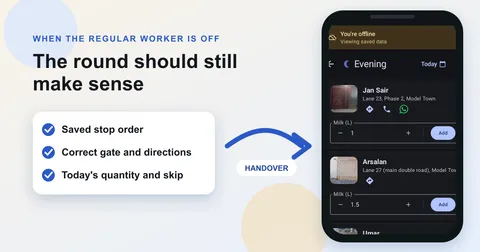
If the signal is weak near the shed, use a workflow that keeps the current animal list available and clearly marks entries waiting to synchronize. Do not create a second paper version unless the business has a rule for reconciling it; two incomplete records are harder to trust than one.
Correct the record without creating a duplicate
If a quantity was entered incorrectly, edit that animal’s existing entry for the date and session. A second entry for the same cow in the same morning can make the herd total look complete while quietly counting the animal twice.
Keep correction rights narrow enough that routine entry remains simple and older history cannot be casually rewritten. The owner should know who can correct an old record and why it changed. That is different from inventing an audit system the farm does not use; the basic requirement is one current record, not two competing figures.
If an animal was not milked, do not enter a normal quantity merely to make the list look complete. Leave the work unresolved until the farm confirms what happened and records any relevant factual note. A missed entry, an animal not milked and zero production are not automatically the same event.
Check missing entries before reading the trend
Start the daily review with completeness:
- Are all active lactating animals expected in this session on the list?
- Does each animal that was milked have one entry?
- Is the session correct?
- Were any corrections left unfinished?
- Does the total reasonably match the recorded rows?
A gap in the register can look like a fall in milk even when the animal’s quantity was simply never entered. Fix recording gaps before interpreting a chart or ranking.
The wider small-farm management guide uses the same principle across feed, expenses and dated animal events: first make the record complete, then ask what it means.
Treat a milk change as a question, not a diagnosis
Compare each cow or buffalo with its own recent records and the same session where possible. A farm with cows and bhains does not need one universal “good yield” number, and this article does not provide one.
When a record changes, check the entry first. Then consider the factual context already known to the farm: stage of lactation, a feed-plan change, a missed session or another dated event. If the animal may be unwell, use the record to explain the change to a veterinarian. Do not use an app trend to diagnose disease or choose treatment.
The useful question is not “Did the app find the cause?” It is “Which animal and which session need a closer look?”
When a notebook is enough—and when an app helps
A notebook can be enough when one person records every session, animal identities are unambiguous and the owner can review the pages without rebuilding totals. Paper has no battery and is familiar beside the shed.
An app becomes useful when the farm needs to:
- keep the animal list and milking order current;
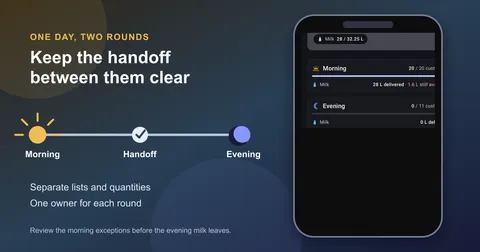
- separate morning and evening records;
- see missing animals before the session is forgotten;
- open one animal’s history without searching several registers; or
- let an authorised worker record milk without keeping a private notebook.
Software does not repair a careless process. If workers share logins, choose the wrong animal or fill every row at the end of the week, the digital record will still be weak.
How DairyTrack handles per-animal milk records
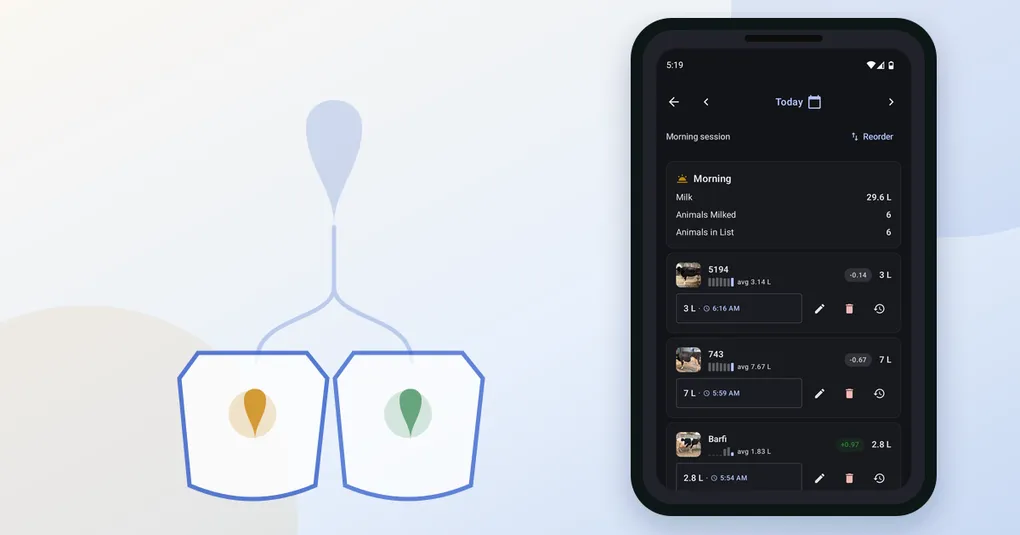
In DairyTrack’s farm management workflow, the milking screen shows active lactating cows and buffalo in the order the business chooses. The user selects the date and session, records one quantity per animal, and can see the session total plus how many animals are recorded or still missing. Each animal also has a history that can be filtered by date and session.
The current Android workflow keeps cached animal and milking data available during weak connectivity and can queue a new milking entry for later synchronization. Corrections to older entries can depend on permission and connection. That narrow offline behavior should not be read as a promise that every DairyTrack workflow works identically offline.
DairyTrack can show a change in the records. It does not explain the cause, recommend a ration or treatment, connect to milking-parlour hardware, or replace a veterinarian.
Get DairyTrack on Google Play and start with the next real session: put the animals in milking order and record the quantity against each animal instead of writing only the herd total.
Keep reading