How to cover a milk round when someone is sick or on leave
To cover a milk round when someone is sick or on leave, freeze today’s scope, give one person ownership and hand over the saved stop order, correct gates, directions, quantities and exceptions. Record every delivery or skip during the round, then check unfinished stops before the substitute goes home.
The mistake is to treat the absence as a route-planning meeting. If the morning load is ready, the owner needs a usable round now—not a perfect new system by next week.
How to cover a milk round when someone is sick or on leave
Use this order:
- Confirm which morning or evening round needs cover.
- Choose one person who owns its completion.
- Give them the route in stop order with house details and today’s exceptions.
- Record each delivered quantity or skip at the gate.
- Review unfinished stops and collected payments before closing the round.
If the substitute has to keep calling the sick worker for every second house, the route is still living in one person’s head. The immediate job is to finish today; the longer-term job is to remove that dependency before the next absence.
Decide what must run today
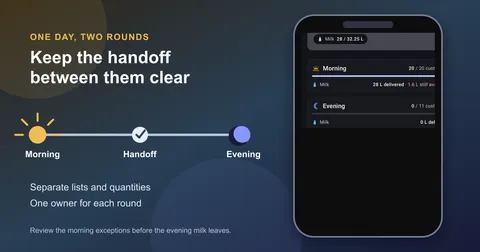
Start with the exact round, not the whole business. Is the worker missing the morning route, the evening route or both? Is another person already responsible for one time slot? The guide to running morning and evening rounds explains why those responsibilities should stay separate.
Do not add optional changes while arranging emergency cover. Keep today’s customer list, regular quantities and route order unless there is a real exception. A sick day is a poor time to reorganize every stop or train someone on a new collection rule.
Check the load against the planned round before it leaves. This does not guarantee every quantity will remain unchanged—a customer can still ask for less at the gate—but it prevents the cover person starting with an obviously incomplete load.
Give one person ownership of the cover round
Name one person who is responsible for the round being finished and checked. Someone else can drive, carry cans or cover a few distant stops, but the owner should not end up asking three people which houses remain.
For a short round, splitting it may create more coordination than it saves. For a long round with two capable people, divide it at a clear stop or area and make one person responsible for reconciling both parts. Use the two-worker split guide if that is necessary.
The cover person also needs practical access before leaving: the correct phone or signed-in account, enough battery, and any key or cash-handling instruction required for the round. Do not improvise broad staff access that they do not need.
Give the substitute stop details, not just names
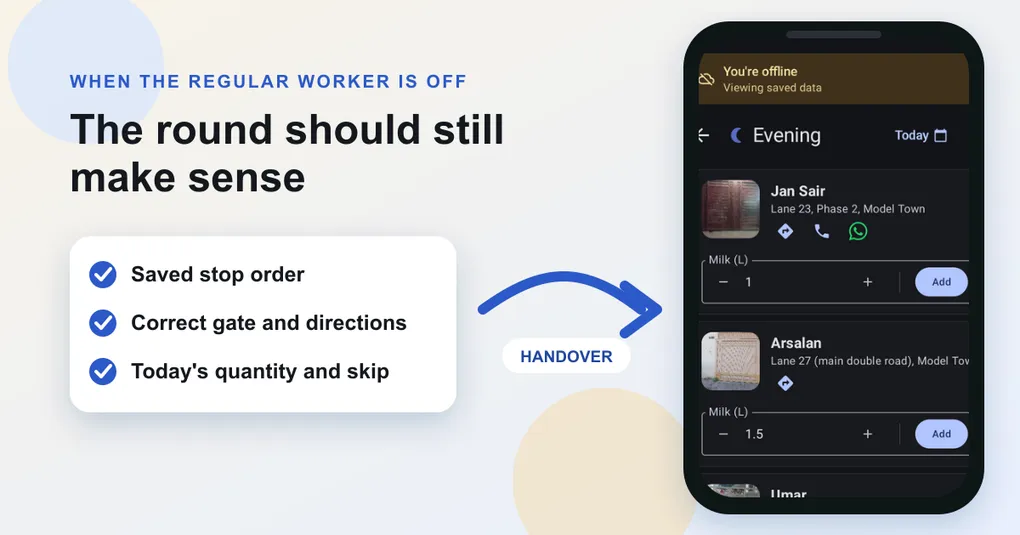
“Go to Aslam in Model Town” is not a delivery instruction. A useful stop record should show:
- its place in the route;
- the saved location or directions;
- a recognisable house, gate or storefront photo;
- the regular quantity for this round;
- the phone or WhatsApp action when contact is needed; and
- a short delivery note, such as which entrance to use.
The photo matters when an address ends at an unnumbered lane or two neighbouring gates look similar. Directions get the worker to the street; the gate photo helps them leave milk at the correct house.
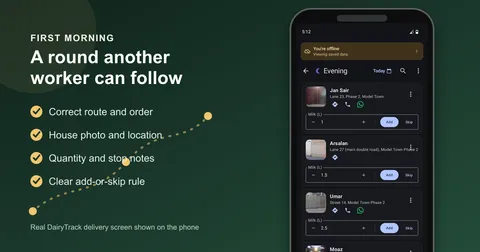
A full first-morning checklist is useful when there is time to train someone. For same-day cover, start with the stops that are hardest to identify and the exceptions that can cause a wrong delivery.
Separate today’s exceptions from regular orders
Review changes since the route was last completed. A customer may have paused deliveries yesterday, asked for a different quantity this morning or changed which gate should be used.
Say whether each instruction is only for today or should change the regular order. A one-day reduction should not silently become the new daily quantity. Likewise, do not remove a customer permanently because they skipped one delivery.
Payment collection needs an explicit rule. If the regular worker normally collects money but the substitute should not, say so before the first stop. If the substitute may collect, record the payment and return it separately from the milk-delivery quantities.
Record the round while it is happening
At each stop, record the quantity actually left or mark the delivery skipped. Waiting until the substitute returns turns the day into a memory test, especially when several customers changed quantities.
If mobile data is weak, a saved route is still more useful than messages scattered across several chats. In DairyTrack, saved round data is designed to remain available offline, and delivery changes can queue to synchronize when the connection returns. The device and account still need to be prepared before the round, and the owner should check that queued work has synchronized later.
Do not treat blank and skipped as the same thing. A blank stop may still be unfinished; a recorded skip says the worker reached a decision for that customer.
Close the round before the substitute goes home
Review the route by customer, not only by total litres. A plausible total can hide one missed house and one accidental extra quantity elsewhere.
Check:
- every due customer is delivered or clearly skipped;
- quantity changes are recorded against the correct stop;
- any cash received is acknowledged;
- complaints or corrected directions are saved for the next round; and
- offline entries have synchronized, or are clearly waiting to sync.
Resolve uncertain stops while the cover person still remembers the gate. Do not wait until monthly billing to discover that no one knows whether a delivery happened.
Prepare the backup before anyone calls in sick
An emergency cover plan is mostly ordinary record maintenance done earlier. Keep the route order current. Replace an old house photo when a gate or storefront changes. Remove customers who have permanently left the round, and put new customers in the correct position.
Ask a backup person to review the route before they are needed. They do not have to ride every day, but they should know how to open the list, follow directions, record a quantity and mark a skip. The broader route handover guide helps move knowledge out of the regular worker’s memory without waiting for a resignation or illness.
What DairyTrack can and cannot carry for you
DairyTrack’s milk delivery management workflow keeps the configured customer order, house photo, location, contact actions and regular quantity together on the round. The cover worker can record the actual quantity or a skip, and the owner can review completion and delivered litres.
It does not choose the replacement worker, optimize the fastest route, track someone live or recover an instruction that nobody recorded. It gives the business a usable route record; the owner still decides who runs it and checks the day.
Get DairyTrack on Google Play and save the difficult gates and directions before the regular worker’s next day off.
Keep reading