How to run morning and evening milk delivery rounds
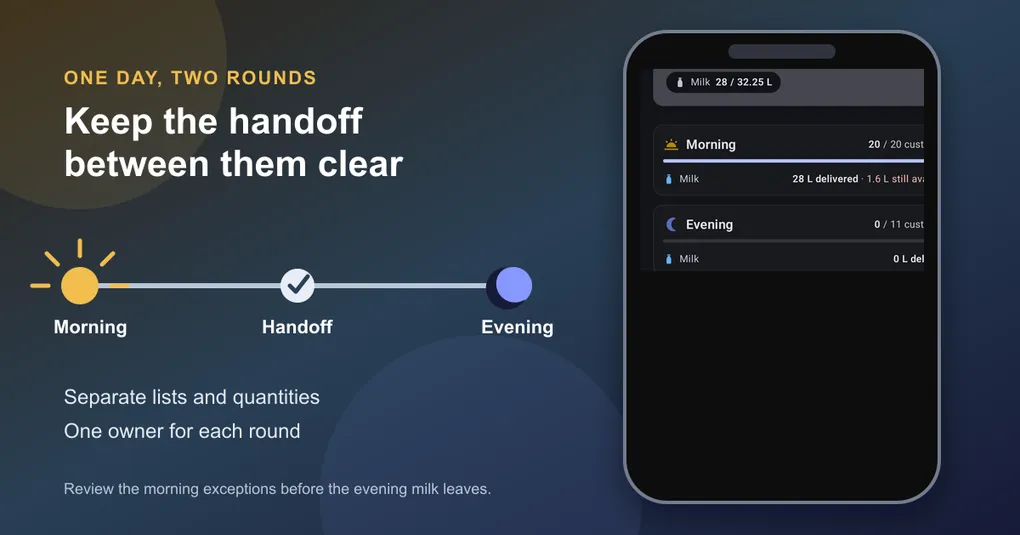
To run morning and evening milk delivery rounds, keep them as two named rounds with their own customer list, regular quantities and responsible person. Record every stop in the round where it happened, then complete one short handoff before the evening milk is loaded.
The risky part is the gap between rounds. A customer tells the morning doodh wala, “Bring less this evening,” but the evening worker follows yesterday’s quantity. Both workers did what they thought was correct; the business still gets the record wrong.
How to run morning and evening milk delivery rounds
Use this daily pattern:
- Open and complete the morning route.
- Review unfinished stops, quantity changes, skips and money received.
- Put evening-only changes into the record the evening worker will use.
- Load and complete the evening route.
- Check both rounds before the day is closed.
This is different from splitting one large route between two workers at the same time. If that is the problem, use the guide to splitting a milk delivery round. Here, the boundary is time: morning responsibility ends, a handoff happens, and evening responsibility begins.
Keep two rounds, not one list with memory rules
A single customer list can look simpler until the exceptions start. Some households take milk twice a day, some only in the morning and some only in the evening. A note such as “evening only except Sunday” is easy to miss when every name appears on one long list.
Put a customer on the round where milk is normally due. If they receive both deliveries, keep the correct regular quantity visible in each time slot. Do not copy every customer onto both rounds just in case; that gives the evening worker a screen full of stops that are not theirs.
The route order can also differ. Morning traffic, a closed market gate or an early office customer may make one order practical at dawn and another practical later. The business should choose both orders deliberately rather than expecting the second worker to reverse the first route from memory.
Give each round one responsible person
One person should own the completion of each round, even when someone else helps carry milk or cover a few gates. “We both handled the evening” is not useful when one customer is still unfinished.
Before the day starts, make four responsibilities clear:
- who records the morning deliveries and skips;
- who checks that the morning round is complete;
- who accepts the handoff and runs the evening round; and
- who closes the day after both summaries are reviewed.
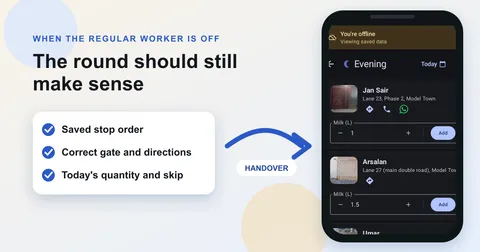
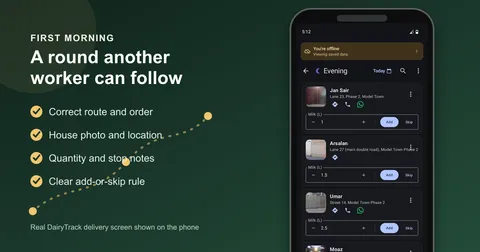
If a new or substitute worker is covering either slot, give them the full stop details rather than only names and litres. The first-morning checklist applies equally to an unfamiliar evening round: saved location, recognisable exterior photo, quantity, note and contact action.
Make the midday handoff short and specific
The handoff should cover exceptions, not repeat the full route. Review what changed after the morning round:
- a customer requested a different evening quantity;
- a household started or ended a holiday pause;
- an address, gate photo or direction was corrected;
- a morning stop remained unfinished; or
- the morning worker received a payment or complaint.
Say whether each change applies only this evening or should become the new regular arrangement. A one-off quantity should not quietly rewrite the customer’s normal order.
Do not rely on a spoken message sent through three people. Record the delivery outcome and put the actionable change where the evening worker will see it. A WhatsApp message can support the handoff, but it should not become the only place the business keeps the instruction.
Record each stop in the round where it happened
At the gate, enter the quantity actually left or mark the stop skipped. Do not wait until night and then divide a combined daily total between morning and evening from memory.
Separate records answer questions that one total cannot:
- Was the morning delivery completed but the evening one missed?
- Did the customer take a different quantity in only one slot?
- Was a skip intentional, or is the evening round still unfinished?
- Which worker should check the gate if the customer disputes one delivery?
The holiday-pause guide explains why a clear skip matters. The same rule holds here: blank, unfinished and intentionally skipped are different situations.
If workers collect payments, define which round may accept them and how the payment is acknowledged. Otherwise both people may assume the other carried the money back. Delivery quantities and payments belong to the same customer account, but they are separate records.
Review both rounds before closing the day
After the morning round, check completion before the evening worker loads. After the evening round, check the whole day.
Look at each route separately first. An overall daily total can hide an evening list with several untouched customers if the morning round was large. Then check the combined day for customer changes that need a permanent update and deliveries that will later feed the bill.
Correct the source record while the round is still fresh. A month-end adjustment may force a bill total to look right, but it will not tell you which time slot was actually wrong.
This review does not need a meeting. It needs a shared definition of finished: every due customer is delivered or clearly skipped, exceptions are recorded, and the next round is not waiting on an unanswered question.
What DairyTrack keeps separate
In DairyTrack’s milk delivery management workflow, routes can be organized by time or area and linked to a milking time slot. The daily delivery screen shows Morning and Evening route cards separately, including customer progress and delivered quantities. Inside the route, the worker can record the actual quantity or a skip, with the customer’s saved house details available at the stop.
DairyTrack does not automatically assign a worker, pass along a conversation that nobody recorded, optimize the fastest route or track the worker live. It keeps the configured rounds and their recorded actions separate enough for the owner to review.
Get DairyTrack on Google Play and check the evening list against the morning exceptions before the second load leaves.
Keep reading