How to bill a new milk customer who starts mid-month
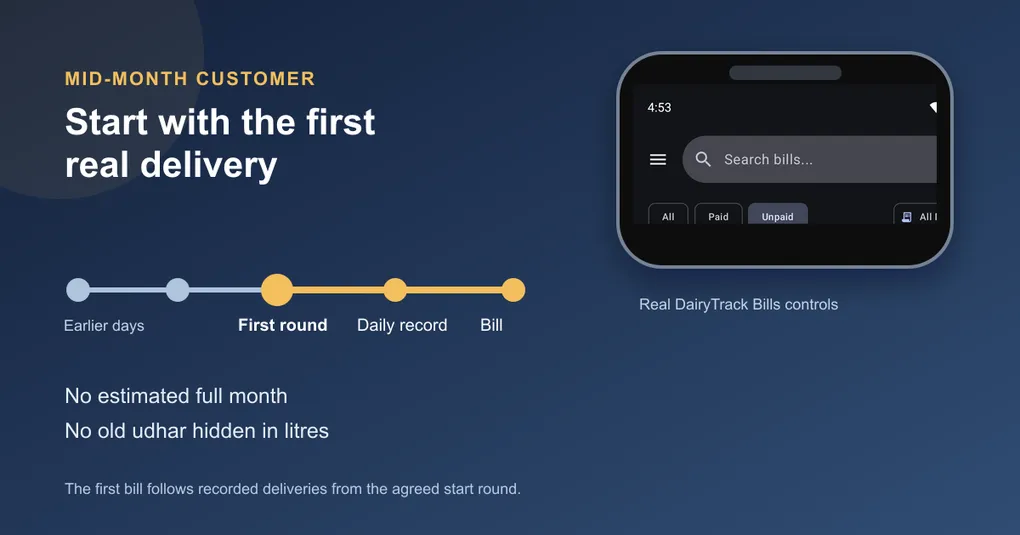
To bill a new milk customer who starts mid-month, agree the exact first morning or evening delivery, save the regular quantity and rate, and record every delivery from that round onward. Build the first bill from those records only. If the customer brings old udhar from another khata, keep it as a separate opening balance.
Do not charge a “half month” by guesswork. A customer who starts on a Tuesday evening, skips Friday and takes extra milk on Sunday does not fit a neat fraction of the normal month.
How to bill a new milk customer who starts mid-month
Use this order:
- Confirm the first delivery round.
- Save the customer, rate and regular quantity.
- Put the correct house in the correct place on the round.
- Record each actual delivery or skip.
- Keep any older balance on its own line.
- Generate and check the part-month bill.
The start date belongs in the delivery record, not only in a WhatsApp message that the person preparing bills may never see.
Agree the first round, not only the first date
“Start on the 15th” is incomplete when the business delivers in both morning and evening. Ask whether the customer expects the first milk on the morning round or the evening round.
Confirm these details together:
- first delivery date and round;
- product and regular quantity;
- customer-specific rate;
- whether any weekday is normally skipped;
- delivery instruction, such as leaving milk with the guard; and
- when the first bill will be sent.
A short confirmation avoids two opposite mistakes: the worker arrives one round early, or the owner leaves the first delivery out of the hisab.
If the customer is replacing another household on the route, do not reuse the old account. The saved gate, rate, payment history and balance belong to different people.
Set up the customer before the first delivery
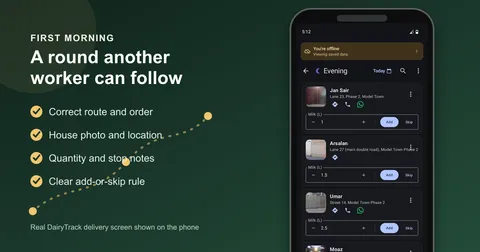
Create the customer while the agreement is fresh. At minimum, save the name, product, rate and regular daily quantity. For a doorstep round, also add the location, exterior house photo and the note the worker needs at the gate.
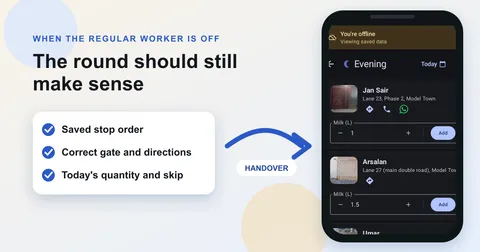
Place the customer in the route where the worker should actually reach them. Adding every new customer at the end may be convenient during setup and awkward on the road, especially when their gate sits between two existing stops.
The regular quantity is a starting value for the delivery screen. It is not proof that milk was delivered. The person on the round still needs to record what happened that day.
This setup connects the billing problem to the milk delivery management workflow: the right account must appear at the right stop before its daily records can support a bill.
Record the part-month instead of estimating it
From the first agreed round, record the quantity that was actually delivered. If nothing was left, mark the stop skipped rather than leaving an unexplained blank.
At month end, total the recorded deliveries from the start round through the final round of the month. Do not fill the earlier dates with the regular quantity. Those days were before the customer started.
This is the same principle used for a holiday: the bill follows actual deliveries and clear skips. The guide to a milk delivery holiday pause explains why a skip and a blank should not mean the same thing.
If your business sells a fixed monthly subscription rather than charging from recorded quantities, the agreement needs its own part-month rule. Decide whether you use a fixed amount, a daily fraction or another stated method, and show it clearly. This article does not invent that rule for you.
Keep old udhar separate from the new milk charge
Most genuinely new customers begin with no previous balance. The exception is someone whose account is being moved from a paper register or another system.
If the customer already owes money, enter that amount as an opening balance with an “as of” date and a short note. Do not turn old udhar into extra litres or spread it across the new deliveries. The first bill should let both sides distinguish:
- milk supplied after the new start date;
- the earlier balance brought forward;
- payments received; and
- the amount still due.
The owner should verify the transferred balance before adding it. Software can carry the figure forward; it cannot decide whether a handwritten amount was correct.
Check the first bill before sending it
The first statement deserves a quick check because it sets the pattern for later months.
Compare the bill with the agreement:
- Does the daily detail begin on the agreed morning or evening round?
- Are all quantities after that point present or marked skipped?
- Is the customer’s agreed rate used?
- Is any opening balance shown separately?
- Are payments and adjustments labelled rather than hidden in the total?
Then send the detail, not only the final amount. The monthly milk bill format guide shows the daily quantities, rate, previous balance, payments and final balance a customer should be able to check.
If something was recorded against the wrong customer, correct the delivery trail before treating the bill as final. Adding a discount to force the total to look right leaves the underlying mistake ready to reappear.
What DairyTrack does and does not automate
In DairyTrack’s milk billing workflow, a new customer can keep a regular product, rate and daily quota, and can be placed in an existing delivery route. An optional opening balance keeps earlier debt or credit separate from new activity.
The normal monthly bill is built from that customer’s recorded, unbilled deliveries in the selected month. A customer with no recorded deliveries does not receive a normal generated delivery bill for that month. The bill can then be shared as a PDF on WhatsApp, and payments remain attached to the account.
DairyTrack does not guess when the customer meant to start, mark unrecorded deliveries as completed or automatically prorate a fixed subscription. The first clean record still depends on the owner and delivery worker agreeing the start round and recording it.
Get DairyTrack on Google Play and add the customer before the first delivery becomes another loose note.
Keep reading