How to manage a home milk delivery business

To manage a home milk delivery business, keep one complete record for each customer, arrange those customers into a repeatable round, record what was actually delivered or skipped, and build the monthly bill from that daily trail. Then make the route usable by a backup worker, so one person’s absence does not stop the business.
The useful system is not a bigger register. It is a clear chain from customer setup to delivery to payment. If a change is recorded at the right point, the owner should not need to reconstruct the month from memory, loose pages and several WhatsApp chats.
How to manage a home milk delivery business
Use the same five-part routine every day:
- Keep the customer’s current delivery arrangement in one record.
- Put that customer in a practical route order.
- Record the real quantity, change or skip at the door.
- Use those daily records to prepare the bill and track payment.
- Keep enough route detail for another authorised person to cover it.
This does not require the owner to watch every stop. It requires clear records and clear responsibility when the normal plan changes.
Give every customer one complete record
A name and phone number are not enough for a recurring milk customer. The record should answer the questions a delivery worker faces at the gate:
- Which house or shop is correct?
- Where is the entrance when the address only names a lane?
- What is the regular morning or evening quantity?
- What rate or product arrangement applies?
- Should the worker ring, call or leave the milk with the guard?
- Is there a current pause or one-off change?
Save an exact location and a recognisable exterior photo where addresses are weak. The pin gets the worker near the stop; the gate or storefront photo confirms the last few metres. Do not photograph people, identity documents or anything inside the home. The delivery needs enough detail to find the correct entrance, not a private album.
Review a customer record when the quantity, rate, phone number, gate or instructions change. An old photo of a repainted gate can be more confusing than no photo because it sends the worker looking for something that no longer exists.
Turn the customer list into a repeatable round
Arrange stops in the order that works on the road, not alphabetically and not merely by signup date. A route may follow neighbourhoods, a main-road boundary or separate morning and evening work.
The shortest-looking order on a map is not always the practical order. A closed crossing, school traffic, market entrance or house reached from a side lane can change the real sequence. The business should choose that order and keep it stable enough for another person to follow.
If one round has grown too large, divide it at an obvious boundary and keep every customer wholly on one list. The guide to splitting a milk delivery round between two workers explains how to avoid duplicated stops and unclear responsibility.
Record the actual day, including exceptions
The regular quantity is a plan. Billing needs the actual day.
At each stop, record what happened: normal delivery, changed quantity or no delivery. Do not mark a customer completed merely because their name appeared on the round. A closed gate, empty can or last-minute message changes the record that the later bill should use.
Handle common exceptions with one rule:
| Situation | Daily record |
|---|---|
| Customer takes the normal amount | Record the delivered quantity |
| Customer asks for extra or less today | Record the actual quantity |
| No milk is left at the stop | Mark the delivery skipped |
| Customer is away for several days | Keep the pause dates clear, then record each affected day correctly |
| Worker is unsure which house is correct | Stop and confirm; do not guess or mark it delivered |
A future reminder can help with a holiday, but it should not replace the daily delivery trail. The customer holiday-pause guide covers pauses and restarts in more detail.
Build the monthly bill from daily deliveries
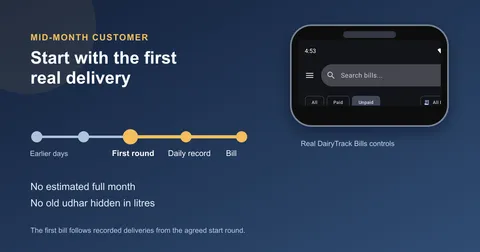
Monthly doodh hisab becomes difficult when the business records only the usual quantity and tries to remember exceptions later. Build the bill from the delivered quantities, rates, skips, adjustments, payments and earlier udhar already attached to that customer.
The customer should be able to see how the total was formed. A clear PDF or message can show the billing period, delivered milk, rate, adjustments, payments and remaining balance. Sending a total without the daily trail invites an argument about the Friday they were away or the morning they took less milk.
Keep “bill sent” separate from “payment received.” Record the amount actually paid and leave any remainder visible. DairyTrack’s milk billing workflow keeps recorded deliveries, PDF bills, payments and outstanding balances together; it is not a replacement for statutory accounts or the business’s bank and cash controls.
Prepare the round for a worker’s absence
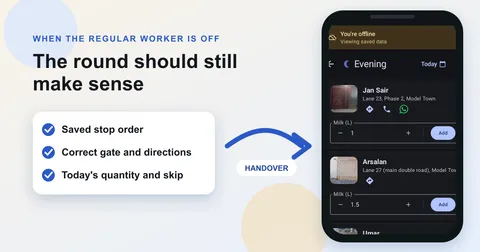
Do not wait until the regular doodh wala is sick, on leave or has stopped coming. Choose who can cover the round and let that person learn the difficult stops while the regular worker is available.
A backup needs more than a list of names. Check that the route has:
- the current customer order;
- saved locations and useful exterior photos;
- regular quantities and time slots;
- phone and delivery instructions; and
- a clear person to contact for exceptions.
If possible, have the backup accompany one normal round. If that cannot happen, start with the stops most likely to cause confusion: two similar gates, an unnumbered lane, a shop reached from the rear entrance or a customer who never answers the bell.
The detailed milk-round handover checklist is useful before a planned absence. On the day itself, the owner should confirm who covers the round, who records changes and who checks unfinished stops.
Review exceptions instead of watching every stop
The owner does not need a phone call after every delivery. Review the places where the plan and the day differed:
- customers still unfinished at the end of the time slot;
- changed quantities and skips;
- new or moved customers;
- a repeated problem finding the correct gate;
- payments that do not match the customer account; and
- one worker repeatedly leaving the assigned area.
Fix the underlying record when the same problem returns. If the gate photo is wrong, replace it. If a customer sits awkwardly between two routes, move that customer rather than redrawing the whole round. If a worker received an instruction only in personal chat, add the useful part to the customer record.
Where DairyTrack fits
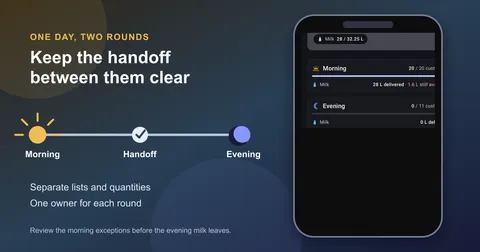
DairyTrack’s milk delivery management workflow keeps customers in owner-chosen routes with saved locations, house photos, contact details and regular quantities. The person running the round can record the actual delivery, adjust the quantity or mark a skip. Morning and evening progress remains separate, and saved work is designed to remain available when the signal drops and synchronize later.
Those delivery records feed the customer account used for bills, payments and outstanding balances. DairyTrack does not choose the fastest route, assign a worker automatically, track a worker’s live location or supervise whether instructions were followed. The owner still decides the route and the people responsible for it.
Get DairyTrack on Google Play and start with one difficult customer: save the correct gate, location and regular quantity, then record the next real delivery.
Keep reading